Learning Balance Is Important
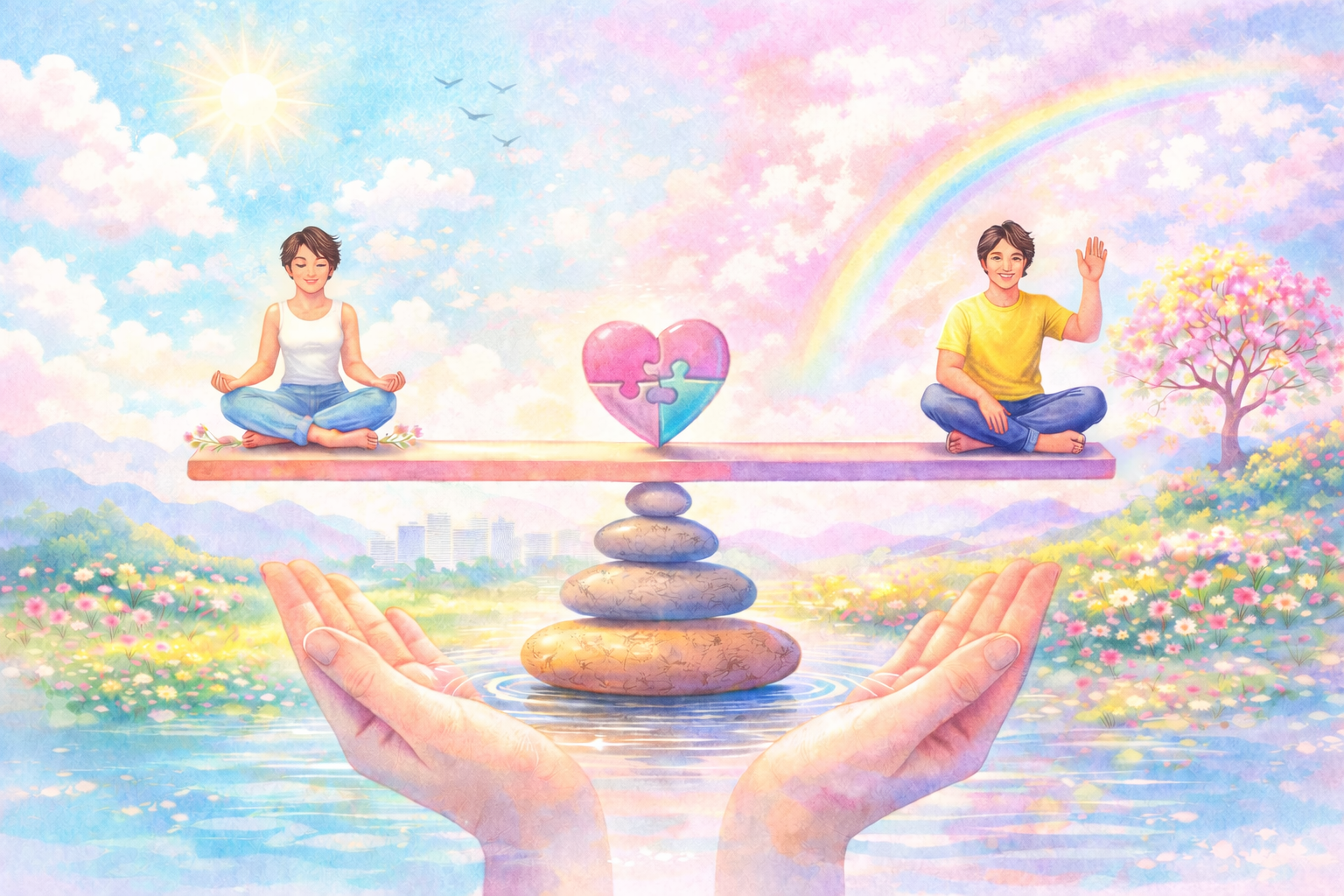
When I sit with clients in trauma therapy, one of the themes that comes up again and again is black-and-white thinking. People who have gone through trauma, dysfunction, narcissistic abuse, emotional abuse, sexual abuse, or simply prolonged stress often find themselves living in extremes. Everything feels all good or all bad. A person is perfect or terrible. Life is amazing or completely hopeless.
From a developmental perspective, this makes sense.
As children, we rely on categorizing the world into “good” and “bad” to feel safe. Clear rules help us understand where we stand. If I know what’s good and what’s bad, I know how to survive. That kind of categorical thinking is protective and developmentally appropriate early on.
Splitting and Object Relations
In psychodynamic theory, particularly in early object relations work influenced by Sigmund Freud and later theorists, there is a concept often referred to as splitting. This refers to the inability to integrate the “good” and “bad” aspects of self or others into one cohesive whole.
In early development, a child may experience a caregiver as either a “good object” (soothing, loving, safe) or a “bad object” (frustrating, unavailable, scary). Over time, with healthy development and consistent caregiving, these split perceptions integrate. We begin to understand:
-
Good people can do hurtful things.
-
Imperfect people can still love us.
-
I can make mistakes and still be worthy.
But when trauma disrupts development — when there is instability, abuse, neglect, or chronic stress — that integration process can stall or not happen at all. The nervous system prioritizes survival over complexity. The brain clings to certainty.
This is where splitting can show up later in life.
It is commonly discussed in the context of borderline personality disorder, where someone may move quickly between “you’re amazing” and “you’re terrible.” But splitting is not limited to any one diagnosis. It can occur in many trauma survivors. It is a trauma response — a survival adaptation.
And living in extremes is exhausting.
What Black-and-White Thinking Looks Like in Real Life
Sometimes it can look like this:
-
“My life is completely ruined.”
-
“Everything is perfect.”
-
“I’m a terrible person.”
-
“I’m better than everyone.”
- “I failed, so I might as well give up.”
Other times it can look like addiction:
-
“I’m going to eat everything today because I deserve it — tomorrow I’ll go on a strict diet.”
-
“I’ll drink as much as I want this week — I’ll quit for good on Monday.”
These patterns often show up in addiction cycles, perfectionism, relationship instability, or intense shame spirals. In relationship therapy, I often see how splitting impacts partnerships — idealization followed by devaluation, especially in those who have experienced narcissistic abuse or emotional abuse.
When trauma keeps the nervous system in survival mode, integration feels unsafe. Balance feels unfamiliar.
Why Learning Balance Matters
As we mature, we are meant to move toward integration. We learn there is a continuum — a spectrum — of behavior and experience. People are complex. Life is layered.
Balance is not about suppressing intensity. It’s about expanding capacity.
In individual therapy — whether through EMDR therapy, somatic trauma therapy, dialectical behavior therapy (DBT), or mindfulness — we work on increasing a person’s tolerance for nuance. DBT, in particular, speaks directly to dialectics: two things can be true at once. I can love someone and be hurt by them. I can be doing my best and still need to grow.
In trauma-informed care, we approach black-and-white thinking with compassion. Instead of shaming it, we get curious:
-
When did this protect you?
-
How did this help you survive?
-
What felt unsafe about the middle ground?
Often, extreme thinking was adaptive in childhood. It created order in chaos. It offered psychological safety when the environment did not.
But what protects us at one stage can limit us at another.
The Pendulum and the Middle
I often describe healing as a pendulum. Sometimes we swing to one extreme. Then we swing to the other. Over time — with support — the swings get smaller. Eventually, we begin to find the center.
Balance doesn’t mean perfection. It means flexibility.
For example:
Instead of:
“I ate everything. I’m terrible. Tomorrow I punish myself.”
Try:
“I ate more than I wanted. I’m still a good person. Tomorrow I’ll try to eat in a way that feels nourishing.”
Instead of:
“I failed. I’m worthless.”
Try:
“I’m a good person who made a mistake.”
This is integration. This is growth.
Healing the Split Through Trauma Therapy
Through trauma therapy — including EMDR therapy, somatic trauma therapy, mindfulness, and DBT — we can help the brain and nervous system update/rewire old survival patterns. EMDR allows the brain to reprocess traumatic memories so they no longer trigger extreme threat responses. Somatic work helps regulate the body so it no longer reacts as if every disappointment is catastrophic. Mindfulness builds awareness of internal states without judgment.
Over time, the brain learns that complexity can be safe and is not a threat.
You can be imperfect and worthy.
Others can be flawed and still human.
Life can be hard and meaningful at the same time.
A Gentle Invitation
If you notice yourself living in extremes — whether in relationships, food, alcohol, self-worth, or how you view the world — I invite you to get curious rather than critical.
Ask yourself:
What do you think this way of being protects you from/how did it keep you safe?
When did you learn this (or what are the earliest examples of this in yourself and others)?
What would balance look like today?
Learning balance is not a quick fix. It’s a lifelong practice. But it is possible.
If you’re looking for trauma therapy, EMDR therapy, or individual therapy in Westlake Village, Thousand Oaks, Agoura Hills, Calabasas, Oak Park, Ventura, Los Angeles, or anywhere in California through online sessions, this work is something we can explore together. I also offer in-person sessions locally.
You do not have to live in extremes forever. There is a middle ground. There is integration. There is safety in balance.
And you deserve that.